

Writing advice is everywhere.
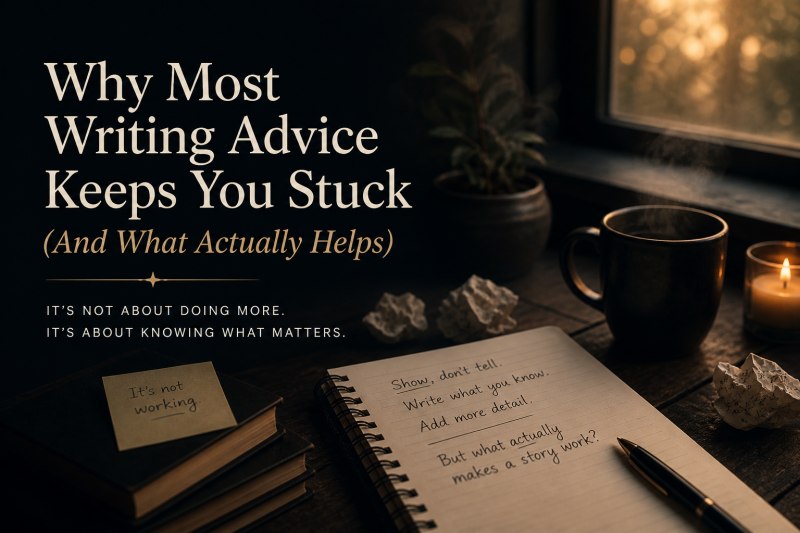
“Show, don’t tell.”
“Write what you know.”
“Add more detail.”
And for a while, it feels helpful.
Until it doesn’t.
Because at some point, you realize something frustrating:
You know the advice —
but your writing still doesn’t feel right.
It’s not that the advice is wrong.
It’s that it’s incomplete.
Most writing advice tells you what to do —
but not how or when to do it.
So you end up doing everything at once.
Showing everything.
Describing everything.
Trying to get everything right.
And that’s usually when writing starts to feel heavy.
The biggest shift for me wasn’t learning more advice.
It was understanding this:
✦ Writing isn’t about doing more.
It’s about knowing what matters in the moment.
For example:
“Show, don’t tell” doesn’t mean
you should describe everything.
It means:
👉 show what matters
👉 skip what doesn’t
The same goes for detail.
More detail doesn’t make a scene better.
It just slows it down —
unless you use it at the right time.
Most writing feels flat not because it’s wrong —
but because it stays on the surface.
It describes what happens,
but not what it means.
And once you see that, everything changes.
If you’ve ever felt stuck between
“doing it right” and “something still feels off” —
you’re not alone.
And you’re not missing talent.
You’re missing clarity.
That’s exactly why I created a short guide:
From Idea to Story
It breaks down:
✦ how to get past the blank page
✦ how to use detail without slowing your story
✦ and what actually makes writing feel real instead of flat
If you want a clearer way to move forward,
you can check it out here:
👉 From Idea to Story — How to Move Beyond the Blank Page and Write What Actually Works
Add comment
Comments