

When most people think of a gorgon, they think of snakes for hair, glowing eyes, and the ability to turn people to stone with a single glance. Thanks to movies, games, and fantasy books, Medusa has become one of the most recognizable creatures from Greek mythology. But like many ancient myths, the real story is far more complicated — and far more tragic.
Because Medusa was not always a monster.
In some versions of the myth, Medusa was once a beautiful mortal woman and priestess in the temple of Athena. There, she was assaulted by Poseidon. And yet, instead of Poseidon being punished, Medusa herself was cursed and transformed into a creature so horrifying that anyone who looked at her would turn to stone.
Even thousands of years later, the story still feels disturbingly familiar.
There is something deeply uncomfortable about the fact that Medusa loses her humanity after something terrible is done to her. She becomes feared, isolated, and ultimately hunted down by heroes, as though the trauma itself transformed her into something monstrous in the eyes of the world.
And perhaps that is why Medusa still fascinates people today.
Because once you look beyond the snakes and stone, her story becomes about blame, fear, punishment, and the way societies often treat victims. It is difficult not to notice how many ancient myths punish women more harshly than the powerful men who harmed them. Greek mythology, for all its beauty and imagination, is filled with gods who act recklessly while others suffer the consequences.
In many ways, Medusa has evolved from monster into symbol.
Today, some people see her as a representation of feminine rage, survival, or protection. Her gaze becomes more than a curse — it becomes defense. If the world insists on seeing her as a monster, then perhaps becoming dangerous is the only way to survive.
But Medusa is not the only gorgon.
In Greek mythology, she had two sisters: Stheno and Euryale. Unlike Medusa, both sisters were immortal. Together, the three gorgons were often described as daughters of the ancient sea deities Phorcys and Ceto.
This creates an interesting contradiction in the mythology.
Were gorgons a race of ancient creatures? Or was Medusa something entirely different — a human transformed into one?
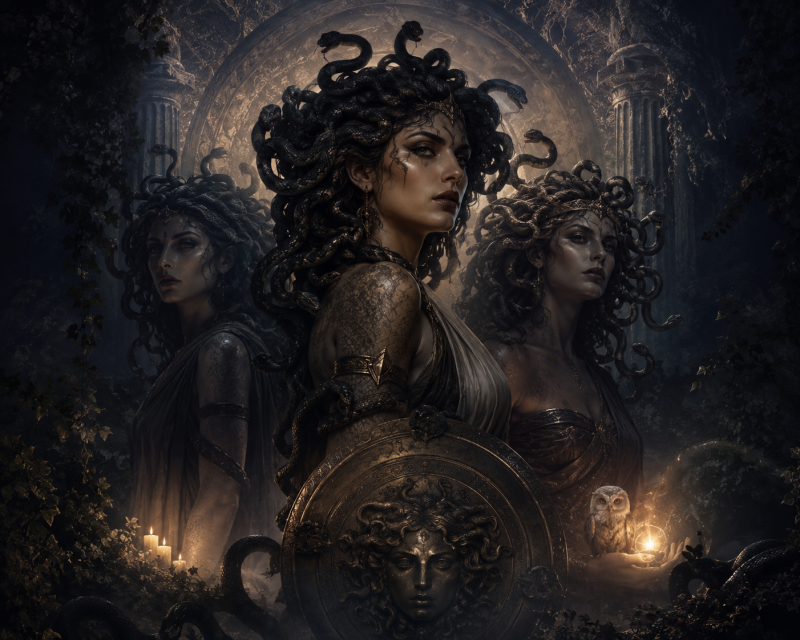
The myths never fully agree.
Earlier Greek traditions often portrayed the gorgons as ancient monstrous beings connected to chaos, death, and primal fear. But later writers, especially the Roman poet Ovid, reshaped Medusa into a tragic figure. Over time, that version became the one many people connected with most deeply.
And perhaps that is because monsters are rarely as simple as stories want them to be.
The symbolism of the gorgon is layered and fascinating. Snakes have long been connected to transformation, rebirth, forbidden knowledge, temptation, and death. The petrifying gaze can symbolize fear, shock, power, or emotional paralysis. Yet despite their terrifying appearance, gorgons were also used as protective symbols in the ancient world. Images of Medusa’s face — called a gorgoneion — were placed on shields, armor, temples, and doorways to ward off evil.
Something terrifying became something protective.
That paradox is part of what makes gorgons so compelling even now. They exist in the uncomfortable space between victim and monster, punishment and power, fear and protection.
And honestly, Greek mythology has a remarkable habit of taking:
“a powerful man did something terrible”
and somehow ending with:
“therefore, the woman has become the problem.”
Maybe that is one of the reasons these stories still survive.
Not because the monsters were frightening —
but because the stories behind them still reflect parts of humanity we have never fully escaped.
Add comment
Comments